What is a slasher deck in a sawmill log yard?
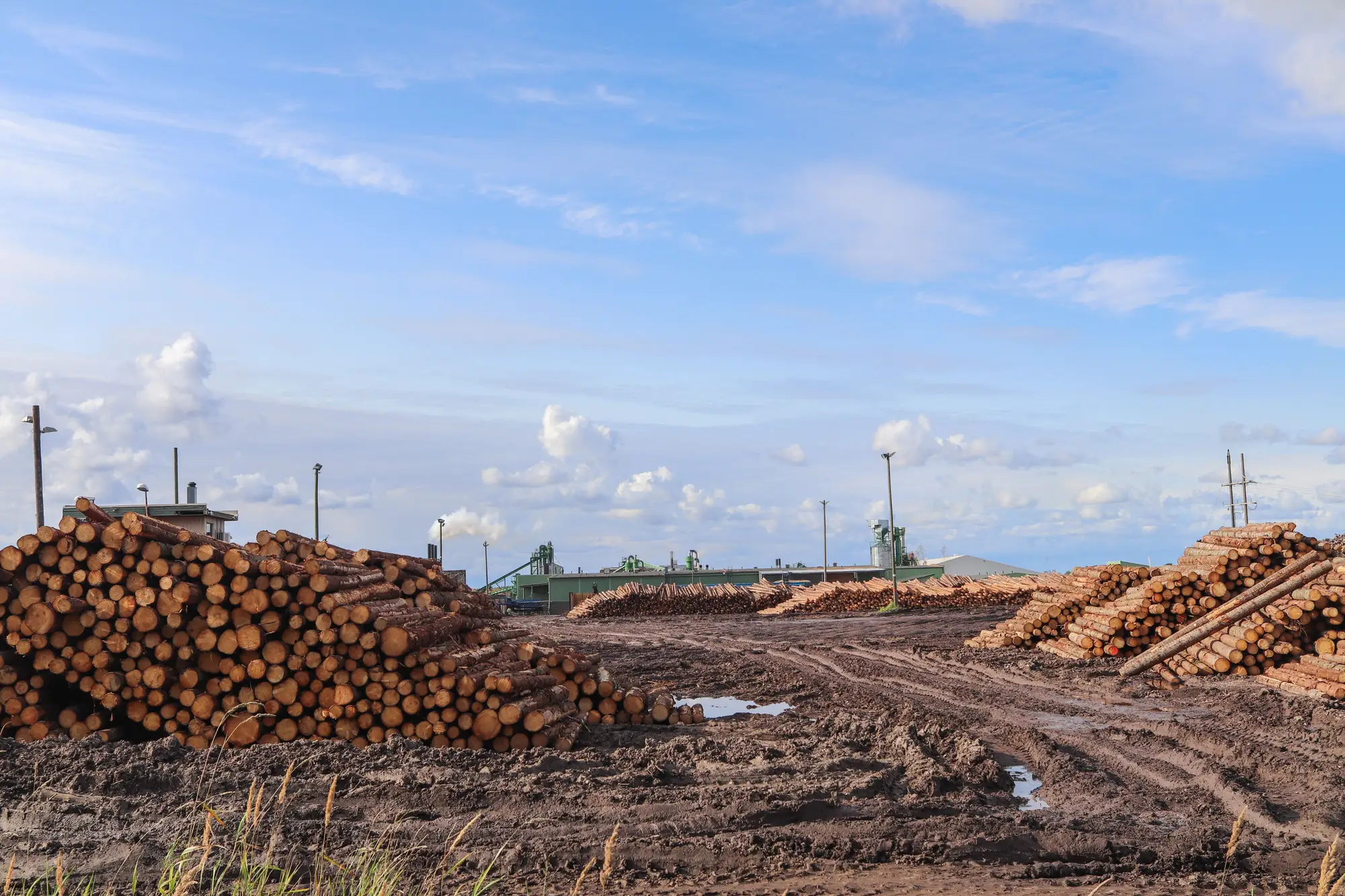
A slasher deck is the station where long stems get bucked to length before they go into the mill. Logs come off the trucks full-length, sometimes 40 feet or more, and the mill needs shorter, graded lengths it can run through the headrig. The slasher deck is where that cut happens, usually with a traveling saw or a fixed saw and a chain or roller deck that feeds the stem past the blade.
Most yards run it as a simple line. A loader or stacker pulls logs off the sort pile and lays them on the infeed chains. The chains walk the stem forward, a measuring device or an operator calls the cut points, and the slasher saw trims it into mill lengths, pulpwood lengths, or cants depending on what the order calls for. The cut pieces drop onto an outfeed deck or conveyor and get sorted again before they go to the log yard's storage decks or straight to the mill infeed.
Slasher deck vs. bucking deck
You'll hear "slasher deck" and "bucking deck" used almost interchangeably in most regions, and for practical purposes they're the same operation: cutting a long stem into shorter, usable lengths. Where mills draw a distinction, it's usually about scale and mechanization. A bucking deck can be a smaller, more manual setup, sometimes just a station where a sawyer with a chainsaw or small circular saw cuts to length by hand. A slasher deck implies the mechanized version: a dedicated saw station with powered infeed and outfeed, built to run volume all shift. Some yards use both terms for the same piece of equipment and nobody corrects anybody. If you're reading a mill's layout or a job posting and see either term, assume it means the cutting-to-length station between the sort yard and the mill deck.
The slasher deck usually sits between two other things worth knowing by name: the sort yard, where logs get sorted by species, grade, or diameter before cutting, and the log deck proper, where cut lengths get stacked and staged for the mill. A yard with a busy slasher deck is moving a lot of wood through that one chokepoint, which is part of why the decks around it tend to stack up or draw down fast when volume shifts.
Why it shows up from outside the fence
A slasher deck is easy to miss from the road or from above, just a saw and a chain run, usually tucked under a roof or a simple canopy. What does show up, and what tells you something about how hard that slasher deck is working, is the log decks on either side of it: the stacked lengths waiting to be cut, and the sorted, cut product staged for the mill. Those decks grow and shrink with throughput. A yard running its slasher deck flat out all week builds inventory on one side and draws it down on the other. A yard that's slow does neither.
That's the part worth watching if you're trying to read a yard's activity without walking the property. The equipment parked around the decks (stackers, loaders, the occasional crane) and the volume sitting in the decks themselves tell you more about how busy a mill is than anything posted on its website. A quarterly pass across the account list, counting that equipment and reading deck volume at each yard, is a faster way to spot which accounts are ramping up before anyone there picks up the phone. That's the read Timber Yard Equipment builds, a per-yard equipment count paired with a deck-volume estimate, run on a quarterly cadence.
If you cover a territory full of sawmills and timber yards and want that same read on your own account list, that's the gap this site is built to fill.