What is a radial-arm log stacker, and why do some sawmill yards still run one?
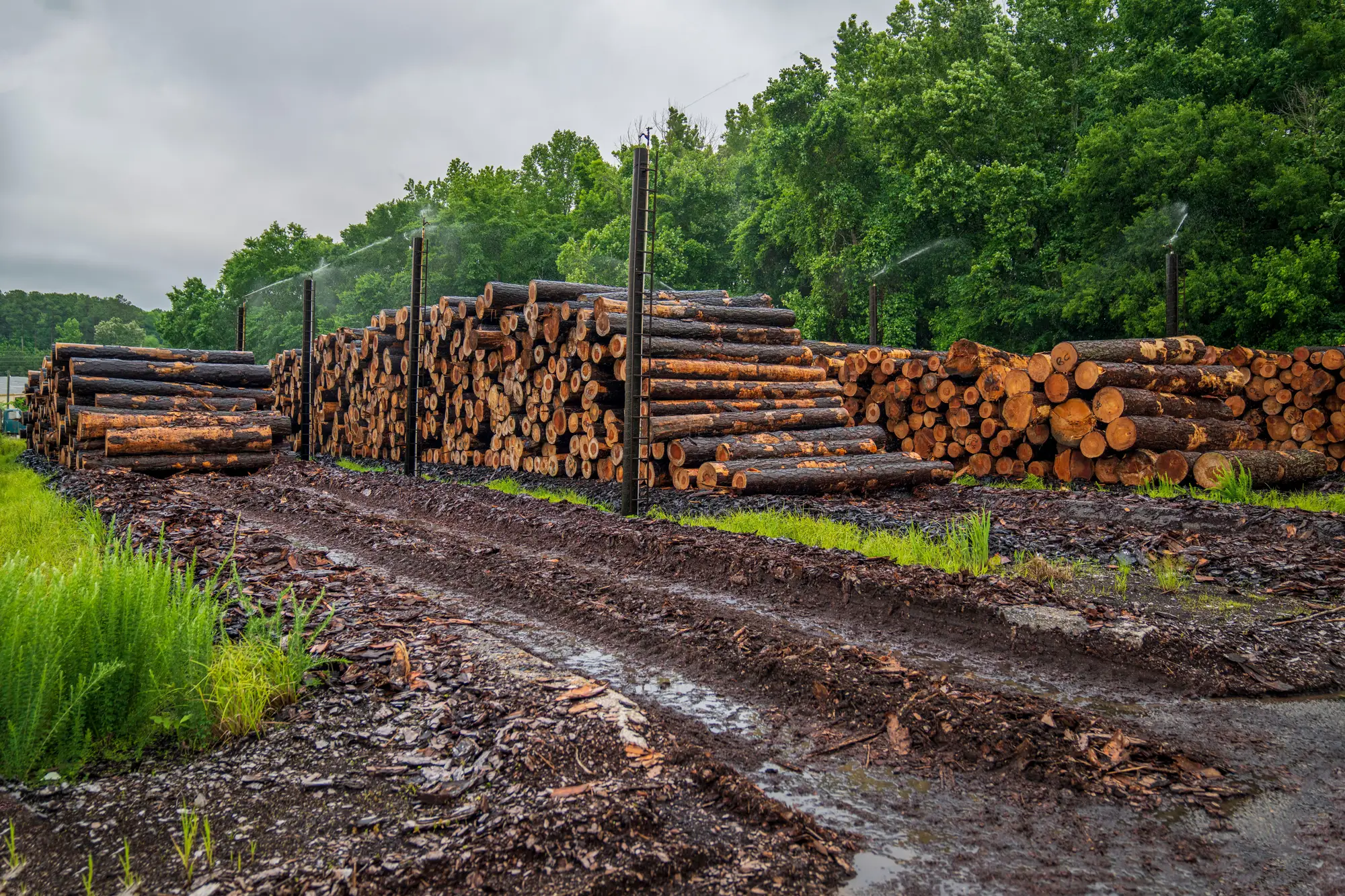
Walk a sawmill yard that's been running since the 1960s or 70s and you'll sometimes still find a machine bolted to a concrete pad, a long steel arm pivoting off it like a clock hand, swinging logs into a fan-shaped pile. That's a radial-arm log stacker, and it's one of the older designs still earning its keep at a handful of yards.
How a radial-arm stacker actually works
The arm pivots around a fixed center point, usually a tower or mast anchored into a foundation. A cable, hydraulic cylinder, or chain drive raises and lowers a carriage or grapple along the arm, and the whole assembly swings through an arc, usually somewhere between 90 and 180 degrees. Logs come in off a truck, a deck conveyor, or a transfer car positioned at the base, and the arm lifts and swings them out to wherever the pile needs building. Because the pivot is fixed, the stacked logs end up radiating outward in that recognizable fan pattern, tightest near the mast and spreading as the pile grows.
It's a stationary system. No rubber tires, no tracks, no operator driving a loader back and forth across the yard. The machine sits in one spot and does one job: take logs from a fixed delivery point and stack them within its arc.
Why some yards haven't replaced it
A few reasons keep showing up when you ask a mill super why the radial arm is still running instead of a wheel loader with a grapple.
First, it's paid for. The foundation, the mast, the drive system, all of that capital went in decades ago, and a yard running steady volume with a predictable species mix doesn't always see the case to rip it out for a mobile unit that costs six figures and needs its own maintenance program.
Second, it doesn't need traffic lanes. A mobile stacker needs clear ground to maneuver, turn, and reposition. A radial arm just needs trucks or decks feeding it from a fixed point, which matters on tight yards boxed in by rail spurs, a river, or a property line.
Third, the crew already knows how to fix it. A radial arm's wear parts are the cable, the sheaves, the hydraulic cylinder, and the bearing at the pivot. A maintenance crew that's kept one running for thirty years has the spare parts bin and the know-how already in place. Swapping to a different log stacker type means retraining the crew and building a new parts supply chain from scratch.
The tradeoffs are real too. A fixed arc means a hard limit on pile radius and log length, so a yard running longer stems or needing to stack farther out has to either live with the constraint or add a second stacking point. Cycle times also run slower than a shovel loader that can grab, carry, and drop in one continuous motion, so throughput per hour tends to lag behind newer mobile equipment once volume climbs.
The other log stacker types you'll see in a yard
Most yards today run some mix of:
- Mobile wheel-loader stackers with a grapple or forks, the most common replacement for radial arms, flexible but needing open ground to work.
- Stacker cranes, overhead rail-mounted systems that span a deck and move logs along a fixed track rather than a swinging arc.
- Knuckleboom loaders, truck-mounted or deck-mounted, common for loading out rather than building long-term piles.
A radial-arm stacker sits at the older end of that lineup, and spotting one in an aerial pass of a yard is a decent tell that the rest of the handling setup hasn't been overhauled recently either.
That's exactly the kind of detail worth knowing before a sales call. Timber Yard Equipment runs a quarterly count of the stackers, cranes, and loaders at each yard and reads the log deck volume alongside it, so you can see which accounts are still running older gear and which ones look due for a sales visit before the mill makes the call itself.
If that's the kind of read you've been piecing together from windshield surveys and old service tickets, it's worth a look at what a quarterly equipment pass can show instead.