What a debarker is, and why its footprint signals mill capacity
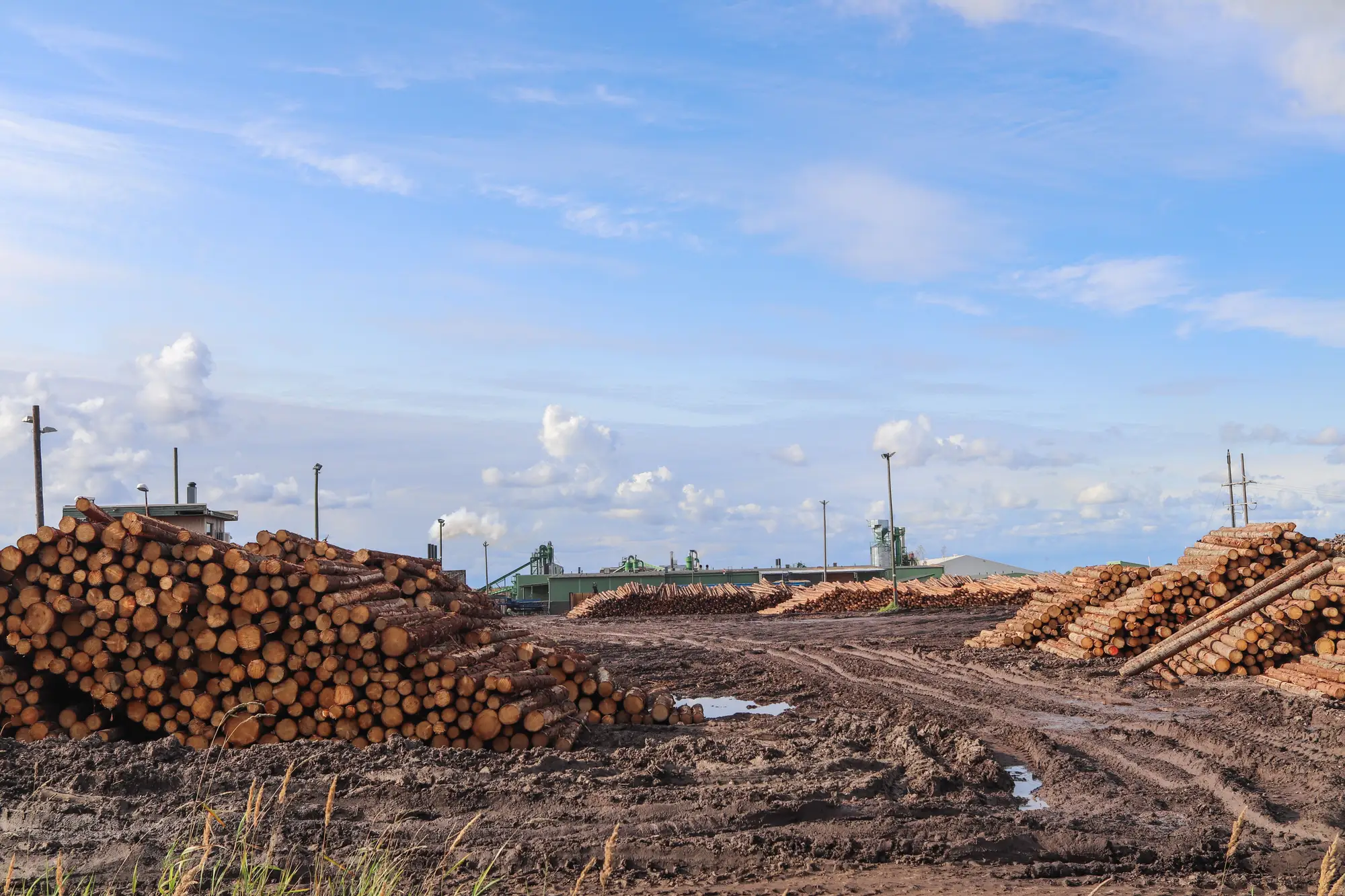
A debarker strips bark off logs before they hit the headrig, nothing more. The machine doing that job, and the pad it sits on, tracks a mill's real throughput closer than almost any other piece of equipment on the yard.
Ring debarkers vs. drum debarkers
Most sawmills run one of two setups. A ring debarker spins a cutting head around a single log as it feeds through, stripping bark with rosin-headed arms or knives pressed against the stem. It's fast on uniform stock and takes up a relatively tight footprint, usually a single in-line structure with a short infeed and outfeed deck.
A drum debarker is a different animal. Logs tumble together inside a rotating steel drum, and the bark comes off from logs knocking against each other and the drum wall, not from a cutting head. Drums handle rough, frozen, or mixed-species wood that would tear up a ring head, and they process in batches rather than one stem at a time. That batch process is why drum debarkers need so much more ground: a loading deck long enough to stage a drum's worth of logs, a drum structure itself, and a bark and chip handling area downstream that a ring setup just doesn't need at the same scale.
Debarking drum size as a capacity tell
Sizing up a yard from the road, or from imagery instead of a windshield tour, comes down to reading the debarking line itself. A debarker's drum diameter and length set a hard ceiling on how much wood a mill can run through it per shift, and that size correlates almost directly with the footprint the structure occupies on site. A 12-foot drum handling 40-foot logs needs a support structure, bark conveyor run, and staging area that a 6-foot unit simply doesn't. You can eyeball mill scale off that footprint before you ever see a production number: the cylinder has to be sized to the mill's intended throughput, and the civil work around it has to match the cylinder.
Same logic holds for ring debarkers, though the signal is a little softer since ring units cluster more tightly and the infeed/outfeed decks do more of the telling than the machine housing itself. A mill running two ring lines side by side is processing a different volume than a mill running one, and the deck space feeding each line backs that up.
Why this beats asking the mill directly
Mills don't publish capacity utilization, and they're not going to tell a competing OEM's rep how close they are to needing a new debarking line. What they can't hide is the physical plant. A debarker footprint that's grown, a second structure added next to the first, a staging deck that's been widened: those show up in aerial and satellite passes the same way they'd show up if you drove the yard, minus the drive.
That's the logic behind reading a yard's equipment count and log deck volume on a recurring basis instead of waiting for a call or a trade show conversation to tell you a mill is scaling up. A quarterly count of stackers, cranes, loaders and deck volume across a yard gives a rep the same read a site visit would, without burning a day on the road for a yard that might not be worth the trip yet.
What the footprint can't tell you
Worth being straight about the limits here. Footprint and drum size point to designed capacity, not current output. A mill can have a 10-foot drum running half-speed on a slow quarter, and nothing about the structure on the ground will show that. What the equipment and deck picture does reliably flag is the ceiling: how much wood this site is built to move when demand is there, and whether the yard around the debarker has room to stage more logs if that ceiling gets pushed.
For a rep trying to figure out which accounts on a territory list are quietly outgrowing their current line, that ceiling, tracked over a few quarters, is the thing worth watching.
If you're trying to spot which yards on your list have added equipment or deck volume since your last visit, that's exactly the gap Timber Yard Equipment is built to close.