Log loader vs. wheel loader: telling them apart in satellite imagery
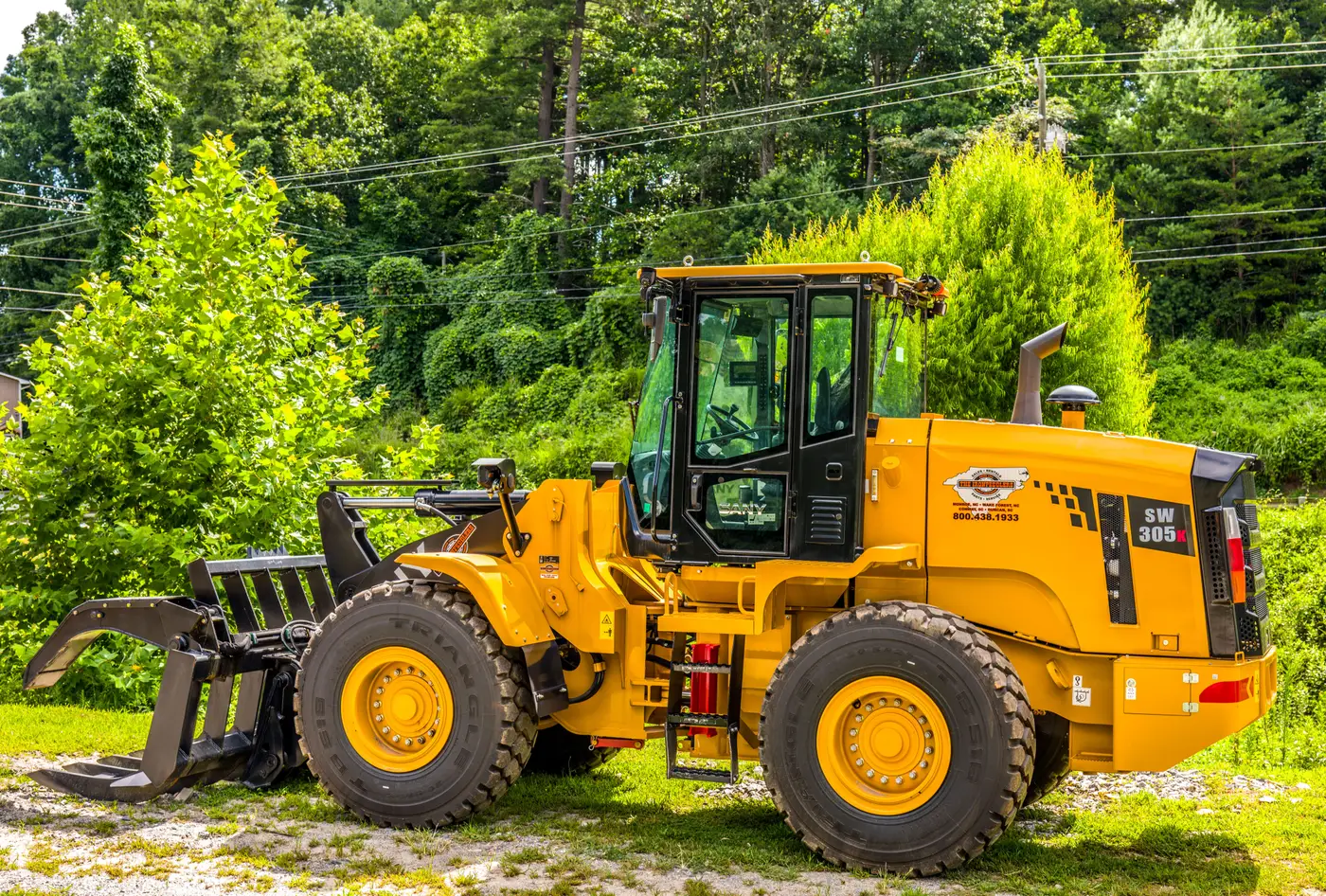
If you've ever pulled up a sawmill yard on satellite imagery and tried to count equipment from the pixels alone, you've probably hit the same wall: a lot of the machines look like gray or yellow blobs with four tires and some kind of arm sticking out. At 0.5 m resolution you're not reading a manufacturer decal off the boom. But you don't need to. The shapes, the shadows, and where each machine parks itself in the yard tell you almost everything.
Chassis shape is the first tell
A wheel loader reads as one solid rectangular mass from overhead, roughly a square or slightly elongated box, with an articulation joint visible as a faint seam across the middle of the chassis. The front end carries the bucket or grapple, which from directly above looks like a wider, blunter nose than the cab end. Tire shadows show up as four distinct dark patches, often with visible track marks in the dirt or gravel radiating out toward the log piles.
A log loader, whether it's a knuckleboom or a heel-boom stacker, breaks that pattern. The chassis itself is smaller and more compact, often mounted on a fixed base or a short undercarriage, and the boom is the dominant shape in the image. At 0.5 m GSD the boom reads as a long, thin linear feature extending well past the chassis footprint, sometimes folded back on itself if the machine is between cycles. That linear boom shadow is the single biggest giveaway. Wheel loaders don't have anything that throws a shadow like that.
Boom arc vs bucket swing
Because these machines get imaged once a quarter rather than tracked frame by frame, you're working off a single snapshot, not a video of the arm moving. But even a still frame carries a clue in the ground pattern around the machine. A log loader working a deck tends to sit at a fixed pivot point for long stretches, and the ground underneath shows a worn arc where the boom has swept back and forth loading the same pile repeatedly. That arc is usually tighter and closer to the machine than anything a wheel loader leaves behind.
Wheel loaders move the whole chassis to do their work. Instead of a pivot arc, you'll see tire paths crisscrossing between the log entry point, the sort deck, and wherever bunks or trucks are staged. If the ground pattern around a machine looks like a worn circle, you're probably looking at a loader. If it looks like a network of tracks between two or three points, that's a wheel loader doing its job.
Where each one sits in the yard
When the chassis shape or the ground pattern is ambiguous, say a machine is partially hidden under a canopy or parked at an odd angle, where it sits in the yard usually settles it. Log loaders cluster at the log decks themselves, set back from the main traffic lanes, because their whole job is stacking and unstacking logs without driving anywhere. Wheel loaders show up at transition points: the unload area where trucks dump logs, the scale house approach, or wherever sawn product gets moved toward the planer or the yard exit. A machine parked at the edge of a deck with a long boom shadow and a worn pivot arc underneath it is a loader. A machine parked mid-yard near a staging area with tire tracks fanning out in multiple directions is a wheel loader.
Scale helps confirm the read. A typical heel-boom log loader chassis plus boom can stretch 12 to 15 meters when the arm is extended, while a wheel loader's footprint, bucket included, usually stays under 10 meters. At 0.5 m resolution that difference is visible as a measurable length difference between two blobs that might otherwise look similar in color and tone.
None of this requires a mill visit or a walk-through with a clipboard. It's the same read an OEM rep would do standing at the yard fence, just done from an overhead image instead of eye level. That's the whole premise behind doing a quarterly equipment count across sawmill and timber yards without setting foot on the property. If you cover a territory with more yards than you can physically visit every quarter, a pass like that tells you which ones picked up a new loader, added a stacker, or let a machine sit idle, before the mill's purchasing department tells anyone.
If you want to see what that per-yard equipment count and deck-volume read looks like for your own territory, Timber Yard Equipment is worth a look.